My first novel was a dark Contemporary Fantasy that I wrote in November and December 2013, when indie publishing was really gaining momentum.
When I sat down to write it (a story for another day), I focused on the relationship between the two main characters. It was set in this fantastic story world that hinged around Amazon-type women being cursed to immortality by a vengeful god. I'd been developing it for a few years and knew what the overall series arc would be, and was just so excited to write it.
I also just knew the story would be a capital-r Romance, because it had this great romance going on between the two main characters and it was definitely a Happy Ever After kind of romance. That made it a Romance, right?
So I labeled it as a Romance, branded it as a Romance, and marketed it as a Romance.
Over the first year and a half of my career, I steadily built a small fanbase. The fourth novel in that series was selected as a finalist in a somewhat prominent Romance writing contest. The books sold ok and gathered some great reviews.
My first breakout, however, came with another book I finished and released in 2015, a Science Fiction Romance with some really interesting worldbuilding. It hit at just the right time to feed underserved SciFi Romance readers and quickly climbed the Kindle charts.
Despite that amazing success, I couldn't quite gain enough traction for my books to stick with audiences.
I tried writing under different pen names in different Romance subgenres, and did find some success there, but only with continual marketing pushes. The minute I quit running ads or had a gap between releases, sales plummeted.
It was frustrating and scary, and it pushed me into a huge bout of burnout that plagued me on and off for years.
A Son's Wisdom
Back in 2015, after that SciFi Romance hit big, my son encouraged me to stop writing Romance in favor of "straight" (i.e. non-romantic) Science Fiction and Fantasy. A couple of years later, he added, "I never thought [your first series] was Romance."
I didn't discount him so much as disagree. My stories contained strong romances. I love reading and writing romance. They must therefore be Romances.
More, I loved being a Romance writer, loved giving readers a strong Happy Ever After. There's a certain brand of hope contained in a well-written Romance that's missing in so much of fiction. I knew my stories tended toward the darker side of fiction, but I still wanted to write the hope.
One day last year, however, I woke up, took a hard look at my career, and knew I had to make a change. It wasn't just the continual pressure to churn out stories for a KU-driven market, or the struggle to sell books that never quite fit anywhere, or the bouts of burnout I'd struggled with since the end of 2015.
On that day, I was hit with a very difficult truth: if I didn't make a change, I was going to burnout to the point that I'd never be able to write fiction again.
Shifting Directions
I began looking at writing non-romantic SFF years before I hit the point where I had to make a change, so last year when I began closing down old pen names, I thought I was ready to dive headfirst into my true calling: Science Fiction and Fantasy with absolutely zero romance.
But when I sat down to write those stories, the words dried up.
It took a long, long struggle and a lot of work for me to realize that romances were integral to some of the stories I wanted to write. Cutting them out dried up all the emotion, and emotion is a huge driver in any fiction. (Not any kind of emotion. The right kind of emotion. Again, a story for another day.)
As soon as I acknowledged that some of my stories needed a romance (not a capital-r Romance, but a strong romantic subplot) to function well, the words flooded back in.
And still, it took a while for me to fully adjust from writing one brand of story to the other, because I had to name the biggest lie I've ever told myself.
It's such a simple lie, so beautiful in its logic: I write stories with romance in them; I must therefore be a Romance writer.
See? Short, clean, and oh, so deadly.
Believing that lie nearly killed my career.
The truth is that I am not a Romance writer and never have been. I write stories that are deeply philosophical, almost mythically so, with a dark, psychological realism not found in most modern Romances; or if Romances do contain some form of psychological realism, they seldom go beyond shallow tropes and archetypes to the underlying roots. Many Romance readers want easily skimmable stories, and there's absolutely nothing wrong with that; I read those kinds of stories myself from time to time. However, skimmable stories require obvious plot points, obvious emotions, and obvious structure.
Whereas my writing tends toward emotional restraint and/or discipline, subtlety, and worldbuilding described through subtext and the characters' day to day experiences.
It wasn't that my Romances were bad so much as that there was a mismatch between my natural writerly voice and the Romance market. My son was right. I should've listened to him years ago.
A Larger Industry Problem
Once this realization fully sank in, I began to wonder how many other women were in the same position, shoehorning their romantic SFF into Romance because they're women, the story contains a romantic subplot, and therefore they must be writing Romances.
My mind immediately jumped to a few specific stories. Radiance by Grace Draven. The Last Hour of Gann by R. Lee Smith. Kushiel's Dart by Jacqueline Carey. Pretty much anything by Jenny Schwartz.
And, of course, I thought of Anne McCaffrey, Robin Hobb, and other female writers who somehow managed to avoid having their stories labeled as Romances even though they often contain romantic subplots.
The thing is, if a woman is writing anything with a romance in it, it's automatically labeled a Romance, even if it isn't. That attitude carried over into self-publishing, where writers like me struggled to make their mark because they were writing romantic fiction, not Romances, and may not even have known the difference between the two.
Especially if they're an intuitive writer (like me) and write from the bottom up (character, story world, or ideas first) rather than top down (structure, genre, tropes, and archetypes first).
So yes, it can be difficult for any writer to distinguish between the two, which can affect the way the story's built as well as how it's marketed.
Acknowledging Truth (when it hits me upside the head)
Though some of my stories contain romantic subplots, they're not Romances, even when or if they end with an HEA.
Some don't even contain a romance in any way, shape, or form. Of the six stories I've written so far under this pen name, only two have romantic subplots ("Menagerie" and "Rumors of My Demise," both published in Night Shadows), and those are very light. The others contain zero romance.
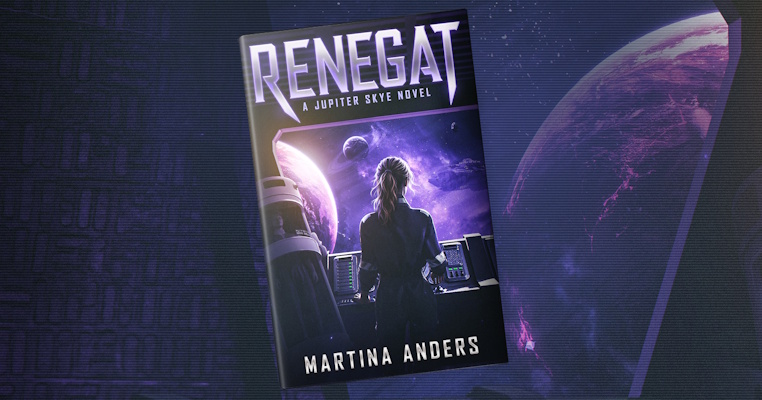
My current priority novel-in-progress, Renegat, contains a very slow-burn romance that doesn't come to fruition until later in the series. I'm not sure how that romance ends yet, only that it happens eventually.
But Renegat isn't a capital-r Romance. It's a Space Opera that shades into Thriller and Noir territory. Like much of my fiction, it's dark, brutal, and violent, and unlike with my pre-Martina Anders stories, I'm holding nothing back as I develop and write it. There's pain and betrayal and a soul-sucking totalitarian bureaucracy, but there's hope, too, and, eventually, friendship and love.
I've chosen to lean fully into who I am as a writer, quirks and all, and my stories reflect that. Love has teeth here, when it chooses to appear. It's not safe or easy. It's not wrapped up in a pretty bow. It sure as hell doesn't shrink to fit a prefabbed trope, or deny the truth of what it is, much like reality, and I no longer box myself in with the lie that stories have to be pigeonholed in order to work.
My stories are benefitting from that change. They contain some of the best writing of my career precisely because I lean into their red of claw and tooth nature, romantic subplots and all, without apology.
It's been such a freeing process.
Very interesting & introspective deep dive into your writing’s inner perceptions. Thank you Martina. Also interesting that your son saw your truth before you did. lol Looking forward to reading all your books. ❤️
He’s always been a perceptive person. I’m blessed to be a part of his life.
Thanks for stopping by! Look for more news on the Jupiter Skye Series soon.