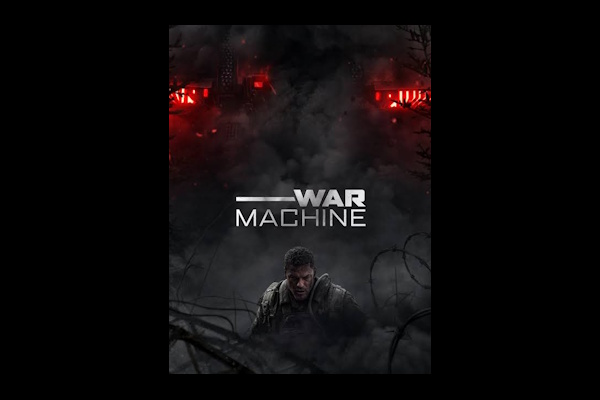
Last night, I took a rare break (after a hectic day spent with family) and watched Netflix's War Machine (2026) starring Alan Ritchson, Jai Courtney, Dennis Quaid, and Esai Morales, along with a host of other talented actors and actresses.
Overall, I enjoyed the movie and would recommend it.
However, the ending irritated me to the point of my *ahem* having opinions about it because of the way War Machine executed a particular trope in the Military SciFi / Alien Invasion subgenre.
The following discussion is not a full review or critique, but it does contain spoilers. If you haven't already, you may want to watch the movie before reading this post.
The Premise
On the surface, War Machine is a visually stunning movie that refuses to flinch from the human cost of war.
The premise is simple, but intriguing. After his brother is killed by the Taliban, a soldier, 81, enters U.S. Army Ranger training to fulfill his brother's dream of becoming a Ranger, where he and other candidates encounter hostile alien life (machines) during the final death march.
The story focuses on 81's internal and external conflicts: his PTSD, the grief of watching his brother die, the guilt of being unable to save him, and the DFQ (don't fucking quit) grit that pushed 81 to enter the Ranger Assessment and Selection Program (RASP). [1]
War Machine mostly worked for me until about two-thirds of the way through the movie when one of the alien machines kills everyone except 81 and 7, another Ranger candidate (portrayed phenomenally well by Stephan James), who was injured in a previous attack. From that point on, 81 becomes an Army of One, destroys another alien machine, and walks across the finish line carrying 7 in an obvious callback to the death of 81's brother.
While this ending closes 81's personal redemption arc, it violates one of the primary tropes of the MilSF / Alien Invasion subgenre, and as a result, War Machine's ending fell flat.
Band of Survivors
This particular subgenre is one of my favorites and I've watched a LOT of movies in this niche: Battleship, Independence Day, Battle: Los Angeles, The Edge of Tomorrow, The Tomorrow War, Starship Troopers, and on and on and on. [2]
The one thing the best of these movies have in common is a particular kind of Found Family dynamic that often comes after personal loss and tragedy. In Battleship, for example, Lt. Alex Hopper (played by Taylor Kitsch) loses his brother, Commander Stone Hopper (Alexander Skarsgård), during the initial alien salvo. Battle: Los Angeles begins after Staff Sgt. Michael Nantz (Aaron Eckhart) loses his entire unit.
In most movies of this kind, however, these losses ultimately culminate in a regrouping (Found Family) that ends with the core group surviving at the end, otherwise known as the Band of Survivors trope.
Now, tropes can be subverted, if done well, but the subversion has to be seeded into the story beforehand, something War Machine failed to do.
In fact, the trope it seeded was...Found Family/Band of Survivors. After the alien machines appeared and killed off a chunk of the death march candidates, 81 began integrating into the remaining group. He took on a leadership role. The group began functioning as one, even as members were killed off one or three at a time.
Yet always, the story focused on 81's interactions with several key characters, namely 7, 44 (Alex King), 15 (Blake Richardson), and 60 (Keiynan Lonsdale). It built the relationship between these characters up until, by the time only they were left, you expected them all to work together to defeat the evil alien war machine. These Ranger candidates became 81's people, transforming him from a wounded loner with a mission into the leader of a well-functioning team.
And then, everybody dies and 81 is alone again. His finding and rescuing 7 closed the movie's symbolic loop while completely ignoring the relational dynamics between 81 and the rest of the team.
The film's makers conflated 81's individual character arc with the story's emotional closure, and ruined the ending.
The high attrition rate was not the problem. Subverting the trope was not the problem.
The way it was subverted? Totally wrong.
The Heart of the Problem
From what I've gathered, the folks behind the movie thought they were making Alien, and they've even compared the upcoming sequel of War Machine to Aliens.
The problem is that Alien and Aliens are in a completely different movie genre underpinned by different tropes with different audience expectations.
While both Alien and Aliens are, obviously, SciFi Horror, Alien in particular is a Final Girl movie. As in, only one person defeats the monster and survives. [3] The entire movie is spent eliminating crew member after crew member. Instead of unifying the team, the Final Girl trope destroys it, leaving Ripley to face the monster alone.
But War Machine is not a Final Girl movie. It's...Independence Day. Battle: Los Angeles. It's Edge of Tomorrow and Battleship and The Darkest Hour (2011) and every other Band of Survivors alien invasion movie ever produced. The promise the first half of the movie made was that at least some members of the newly formed Found Family--the team War Machine spent so much time building around 81--would survive, not just the Final Girl.
Or in War Machine's case, the Final Boy and his Proxy Atonement character.
In other words, the producers, directors, and screenwriters behind War Machine completely misunderstood their story. [4] Comparing it to Alien is like comparing a Mercedes-Benz to a Ferrari. They're both luxury cars, but very different engines live under their hoods.
Aliens, as it happens, is a more apt comparison than its prequel because while it's still very firmly SciFi Horror, it is built on a Military SciFi Band of Survivors premise. I see real promise with that comparison if the people behind War Machine's sequel follow Aliens' lead on the ending.
Tropes Have Power
We often underestimate the power of tropes because they're so often invisible to the viewer, even though they provide a familiar framework onto which consumers hang new-to-them stories. When tropes are subverted poorly or, worse, misunderstood by the writers, the resulting movies may look slick on the surface, but ultimately deliver an unsatisfying experience.
While War Machine successfully resolved its main plot--81's redemption--it still botched its ending, because it failed to resolve the relationships the audience came to care about in the first half of the movie.
War Machine had an opportunity to apply a fresh spin to the MilSF / Alien Invasion genre and failed. Let's hope the studio does better with its sequel.
Footnotes:
- There are a few differences between real Ranger selection and training (RASP and Ranger school are combined in the movie, etc.), but that shouldn't hinder the average moviegoer's enjoyment.
- Not to mention consuming TV shows like Falling Skies and books such as John Ringo's growing supply of MilSF / Alien Invasion series, including the Troy Rising, Posleen War (part of; still reading this one), and Looking Glass series. In fact, I'm currently plowing through Marko Kloos's Frontlines Series. So, yeah. Not gonna claim to be the biggest expert ever, but this niche is definitely a personal favorite.
- Jonesy, being a cat, is naturally exempt from the consequences of the Final Girl trope.
- Director Patrick Hughes thought he was making a Slasher Horror film. Nope.