Tonight I found a stinkbug in the kitchen. When it gets cold in the South, stinkbugs come in for the winter and make pests of themselves until the spring thaw. That's just the way it is down here.
I cannot tolerate having stinkbugs in the kitchen. They love the ceiling and they love dropping into whatever's cooking on the stove, so I scooped the bug up (delicately; they're called stinkbugs for a reason) and threw him outside; and as I was coming back in, I noticed a fine layer of dust on the pots hung on the wall opposite the stove.
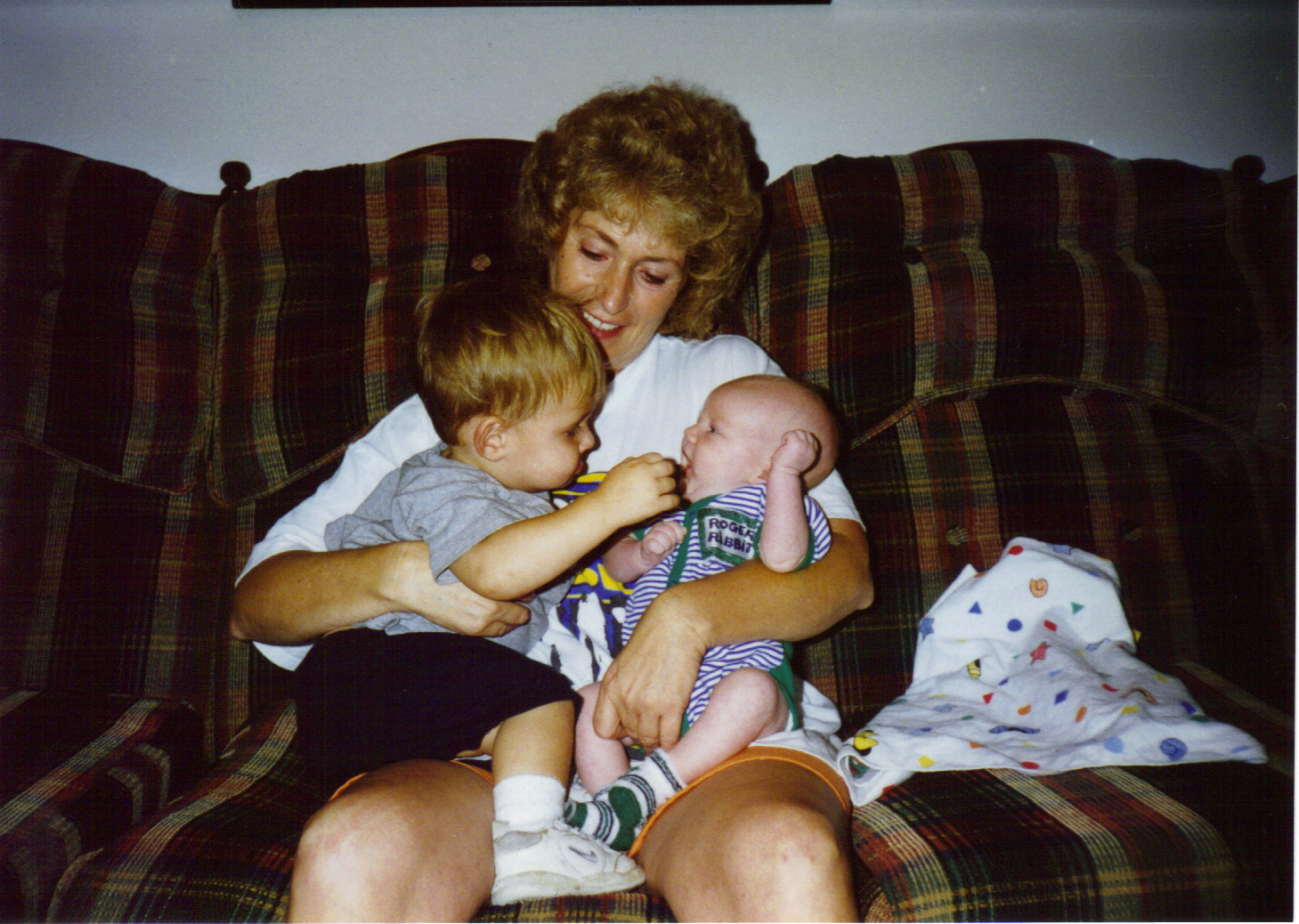
Nobody uses those pots. They're for decoration only. Mom bought them and hung them up in the old house, and now they're hanging here a good fifteen years after she died because nobody can bear to get rid of them.
I saw that dust, and my feet rooted themselves to the floor, and I thought, Mom would never have let dust grow there.
Then I thought, I'm not Mom, but I thought it with a fist clenched at my side while grief welled up in my chest and I stared fixedly at the ceiling trying not to cry, trying not to remember the morning she died and Dad telling me over the phone that she was gone; trying not to remember screaming until my throat went raw, because she always came home.
That was the thing about Mom. She'd get sick and have to be admitted to the hospital, but she always came home. I guess I always thought she would, even if a small part of me knew, rationally, that the day would come when she wouldn't. That there'd always be a phone call on a cool autumn morning, when the sun had barely topped the horizon and fog blanketed the mountaintops in an anonymizing shroud of gray.
Death is the price of living, after all, and the Grim Reaper will not be satisfied until his scythe severs every soul from its mortal coil.
After, when I'd collected myself enough to think, I called my son's grandmother and told her Mom had died. My son had gone down to visit the other half of his family for the weekend, and he needed to come home. He deserved to be here. And when his other grandmother dropped him off, I had to tell him, this child who wasn't yet a teen, that his beloved MeMom, who'd gone to all his games and scouting events, who'd encouraged him and loved him, would never be coming home again.
It was the hardest thing I've ever had to do.
I say all this not because the anniversary of my mother's death is approaching and not to share a grief that hasn't faded one whit in all this time. (Maybe grief like that never fades. Maybe it will always simmer just below the surface, waiting for something so mundane as dust on a pan to trigger it.)
I share this because over the past few months I've been trying to articulate, if only to myself, why I'm so opposed to using generative AI in my own writing. I'm not anti-AI. I don't care if anyone else uses it, so long as I don't have to read it. I'm just not going to use it for writing.
I thought, for a while, that my stance had to do with my own writing style, how quirky my stories are, what oddball structures they follow. I thought my opposition was about being authentic, about the promise I've made to all my readers to give them stories that are wholly, uniquely mine, flaws and all, even if they take a while to write.
But now I think it may be about something else as well.
An AI has never had to sit a child down and explain what death means.
It's never arrived at the funeral home an hour early, only to discover that people are already lined up, waiting to pay their respects; or stayed there, shaking hands and receiving hugs for hours on end while people tell you how much your mother meant to them, how good she was, how she never forgot to ask after their children; or how she sewed their niece's wedding dress or kept score at their son's basketball game; or that time she bet one of the baseball players that she'd do a rain dance on the pitcher's mound if he hit it out of the park on his first at bat, and when he hit a homer on the first pitch, she got up and walked through the fence and whooped and hollered on the pitcher's mound because by golly a woman always honors her word.
And you remember her doing all that. Of course, you do, and those memories well up with the grief, as people press Kleenex into your hands and tell you how much they love a woman you realize you barely knew, even as their faces blur into one and when you finally go home, you can't remember who said what, only that a lot was said.
An AI has never known that kind of grief. It's never given birth or changed diapers when it was delirious with fever because there's no one else to do it. It's never done anything but sit there and spit out responses based on a probability.
It can tell you how a human should feel and whether an emotion is normal or aberrant. Sure it can. It can even name the emotions and order the words correctly as it describes them, but it can never, ever feel what it means to get a phone call about a mother dying alone in a hospital an hour away and her child's heart breaking clean in two.
An AI can never know love or pain or betrayal. It can only do what it's programmed to do. Nothing more, nothing less. And because it can never truly know emotion, it can never genuinely replicate it. It can tell you where the emotion should be in a story. It can generate hollow prose that mimics the shape of emotion, if not the depth. But it can't tell you how love feels. It can't tell you that love, even a good, strong love, can leave a Mom-shaped hole in your heart a decade and a half after she's gone.
Other people can do what they want, and more power to them. Use AI, don't use AI. I don't care.
For my part, I'd rather be slow and human and honest in my writing than let a machine rob my stories of emotions shaped solely by raw human experience.